Understanding the Property Auction Landscape in Polokwane
How Auctions Work in the Limpopo Region
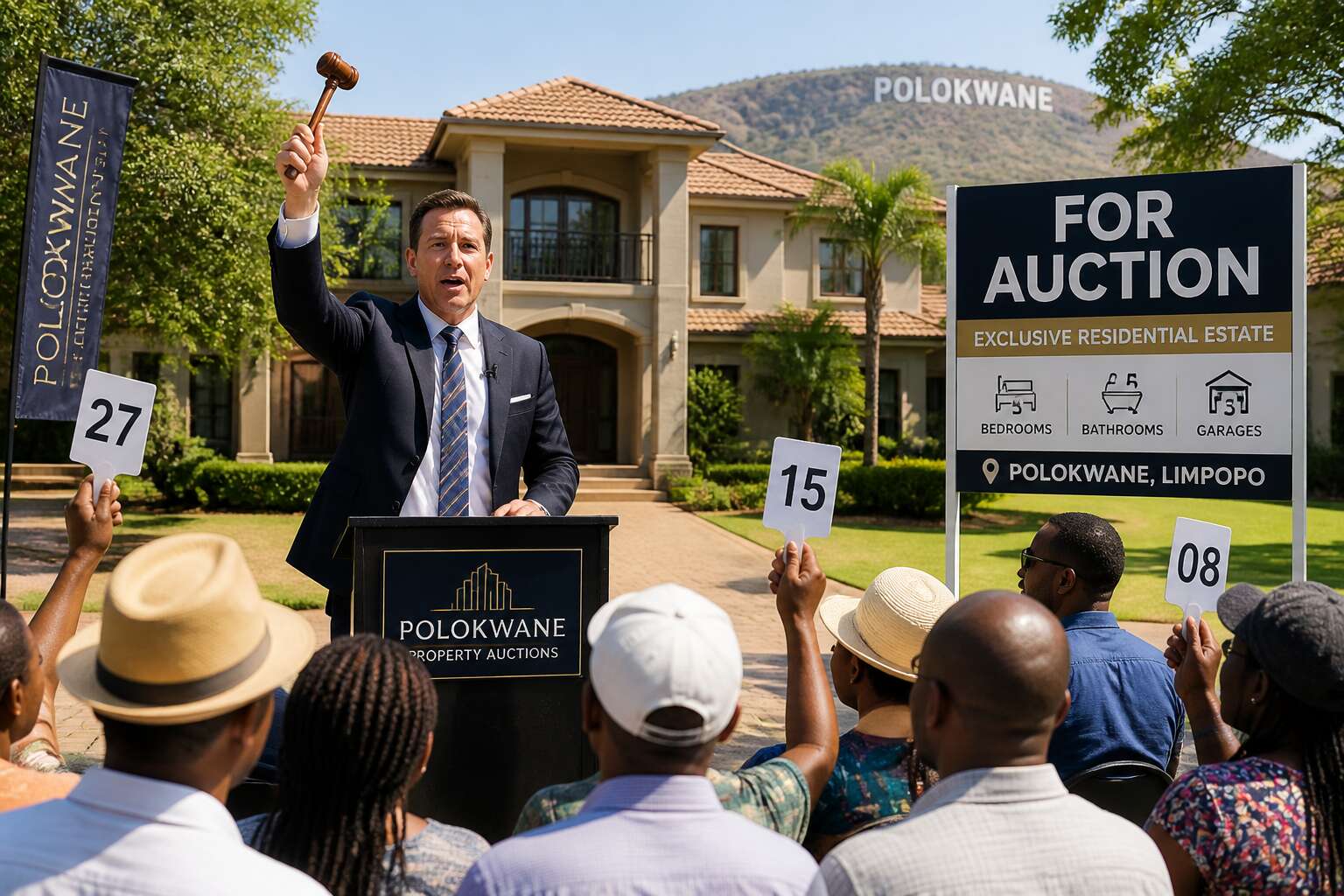
The gavel falls at a property auctions polokwane event with a finality that few private treaty sales can match. In Limpopo’s capital, buyers gather for a process that rewards preparation and punishes hesitation. You register beforehand, prove your deposit, and sign the auction conditions. The auctioneer opens the bidding, and increments climb until only one bidder remains. If the reserve is never met, the property stays unsold.
The local landscape adds its own character. Properties in Seshego, Mokopane, and the city’s northern suburbs draw developers, retirees, and young families. I have watched first-time bidders grip their paddles, then grin when the hammer confirms their offer!
Practicalities matter:
- Transfer duties apply according to municipal value
- Bond guarantees are timed to the auction terms
- Municipal clearance certificates are non-negotiable
These details shape every property auctions polokwane transaction. Understanding them before sale day is what separates serious bidders from the merely curious.
Key Players: Auctioneers, Banks, and Private Sellers
Behind every property auctions polokwane event stands a triad of forces. The auctioneer wields the gavel, reading the room with practiced focus. Banks arrive as reluctant sellers, unloading repossessed houses from defaulted bonds. Private sellers bring inherited estates or distressed assets, seeking liquidation within days.
- Auctioneers verify legal standing. They set the terms of deposit and transfer.
- Banks demand speed. Their reserve prices are fixed by internal valuation.
- Private sellers negotiate no extensions. They want certainty over sentiment.
Each player affects the bidding differently. A bank’s urgency lowers the starting call. A private seller’s attachment raises it. The auctioneer mediates, gauging every offer until the hammer falls.
Types of Properties Available at Auction in Polokwane
Property auctions polokwane rarely follow a predictable pattern. One week, a two-bedroom cluster house in Westenburg crosses the block. The next, a vacant commercial stand on Thabo Mbeki Street awaits a developer’s bid. The catalogue requires careful review!
Properties come from several sources:
- Residential units, from entry-level townhouses to executive family homes.
- Agricultural holdings on the city fringe, often with boreholes and outbuildings.
- Retail and office spaces in established nodes like Bendor and Ivy Park.
- Industrial warehouses near the N1 corridor.
Each type carries its own due diligence burden. Zoning, municipal clearances, and occupancy status weigh heavily on final bids. I’ve seen savvy bidders study the local rates account before the auctioneer ever asks for an opening offer. That preparation separates profit from regret in property auctions polokwane.
Common Myths and Misconceptions About Buying at Auction
Auctioneers in Limpopo see the same pattern every month. I’ve watched buyers walk in convinced property auctions polokwane exist only for distressed sellers, and that assumption costs them money. The landscape covers far more than repossessions and liquidation sales. Private owners, deceased estates, and developers all use the auction method when speed outweighs patience.
The common misconceptions follow a predictable pattern:
- Auctions always deliver bargains. Bidding wars often push prices past market value.
- You cannot inspect the property beforehand. Most auctioneers allow viewings before registration.
- Only cash buyers qualify. Bond approval works, though it changes your bidding strategy.
Each myth stems from outdated practice. The local market moved on. Buyers who examine the auctioneer’s track record and read the conditions of sale enter with clearer expectations, and they rarely face surprises on auction day.
Preparing for an Auction in Polokwane
Researching the Local Polokwane Property Market
Few experiences match the tension of a Polokwane auction room. The real work begins long before the gavel falls. Researching the local Polokwane property market requires digging into municipal valuations, township registers, and historical sale data. You cannot rely on intuition.
Begin with these steps:
- Compare recent sales in suburbs like Bendor and Annadale
- Inspect title deeds for servitudes or restrictions
- Confirm outstanding rates with the municipality
Each piece of evidence shapes your ceiling price. In property auctions polokwane, the buyer who researches hardest often walks away with the best bargain, while the unprepared often overpay.
Property Inspection and Due Diligence Before Bidding
Before attending the auction, treat the physical inspection as your last chance to uncover faults. Bring a builder or an electrician to check for damp, faulty wiring, and structural cracks. Open taps, flush toilets, and test the geyser. These steps prevent costly surprises once the bidding closes.
Due diligence extends beyond the walls. Confirm the property’s zoning, servitudes, and any outstanding municipal debts.
- Approved building plans are essential
- Meter numbers for water and electricity must align
- Unpaid levies or rates shift the final cost
Every detail affects your maximum bid. In property auctions polokwane, the auctioneer waits for no one. A thorough inspection and complete paperwork give you the confidence to bid decisively.
Setting a Budget and Sticking to It: Financial Limits
The gavel falls in under a minute. In that minute, a bidder without a fixed limit can spend R40,000 more than planned! I have seen it happen at property auctions polokwane, and the bidder’s remorse is immediate.
Set your ceiling before the room fills. Your maximum bid must include the hammer price and everything attached: auctioneer commission, transfer duties, legal fees. A pre-approved bond anchors your range, but the final cost determines your true limit.
Every expense counts toward that ceiling:
- Auctioneer commission and VAT
- Transfer duty and conveyancing
- Bond registration and insurance
Add these to the reserve price, and the resulting figure is your true limit. That number, written down, becomes the only reference point when bidding accelerates.
Securing Financing and Pre-Approval in South Africa
In Polokwane, pre-approval is a prerequisite. Banks move slowly; auctioneers do not. A bond pre-approval from a South African lender confirms your affordability, but it does not guarantee funding for a specific property. Auctioneers often demand proof of funds within 24 hours. Without it, your paddle stays down!
Secure financing before the auction date. Approach three banks or a bond originator. Compare interest rates and conditions. Then prepare your deposit. Auction houses in Limpopo typically require 10% of the hammer price immediately. Your pre-approval must cover the balance within 7 days.
Follow this sequence:
- Check your credit score with a bureau.
- Gather payslips, bank statements, and ID.
- Obtain a full bond approval. A pre-qualification is insufficient.
This paperwork determines whether property auctions polokwane become your victory or your forfeiture.
Understanding the Auction Terms and Conditions
Preparation for property auctions polokwane starts with the auction catalogue. The terms and conditions govern the buyer’s premium, the deposit deadline, and the date of transfer. Many bidders discover hidden costs after the hammer falls, when it is too late to withdraw.
Check whether the auctioneer acts as agent or principal. Confirm the deed of sale conditions. Understand the difference between a reserve price and a market value. Some properties sell absolutely, meaning no reserve applies. Others have a minimum bid that must be met.
- Confirm the accepted payment methods.
- Ask about the occupation date.
- Request the conditions of sale before auction day.
The auctioneer’s gavel is final. Read every clause before you raise your paddle.
The Bidding Process and Day of the Auction
Live vs. Online Auctions: Options for Polokwane Properties
The gavel falls differently at property auctions polokwane depending on whether you are sitting in the room or watching through a screen. Live auctions carry a palpable energy, a rhythm of raised paddles and rapid calls that can sweep you along. Online auctions demand a colder discipline. You sit alone, watching a countdown, making decisions in silence.
Both paths follow the same sequence on the day:
- Bidder registration and paddle collection
- Opening bid and subsequent increments
- The fall of the hammer and immediate contract signing
Registration closes before the event, and your deposit must be cleared. The auctioneer opens the bidding, and the pace can change without warning. Your budget work steadies you when the rhythm quickens.
What Happens When the Hammer Falls: Post-Auction Process
At property auctions polokwane, I have watched the bidding escalate in deliberate increments. You raise a hand, nod, or lift your paddle. The auctioneer acknowledges each bid with a glance. Some buyers bid early to assert intent. Others wait for the pace to slow. Neither approach guarantees success.
Then the hammer falls. That sound converts your bid into a legal obligation. You sign a memorandum of sale immediately, and the auctioneer’s clerk collects your details. You pay the deposit on the spot. The post-auction process follows a fixed sequence:
- The auction house confirms the sale in writing.
- Your conveyancer receives the contract.
- You arrange the balance payment before the deadline.
- The transfer lodges at the Deeds Office.
The full amount transfers only when the deed registers. Until then, the property remains under the conditions of sale. At property auctions polokwane, the paperwork after the hammer is just as decisive as the bidding itself.
Legal and Financial Considerations Post-Auction
The Deposit and Payment Deadlines: What to Expect
The hammer falls, but the real pressure begins moments later! Winning a bid at property auctions polokwane triggers immediate financial duties, and the first one is the deposit. Expect to pay between 5% and 10% of the purchase price on auction day itself. Nothing else happens until that money clears.
Legal timelines vary by auction house, but most stipulate a strict deadline for the balance, often within 30 days. Missing that window can forfeit your deposit and expose you to legal action. Typical post-auction payment requirements include:
- A bank-guaranteed cheque or electronic transfer for the deposit.
- Proof of funds or financing approval within 48 hours.
- Signed auction contracts returned by the close of business.
These deadlines are non-negotiable. The ancient Roman maxim caveat emptor applies, but so does contractual precision. Understand every clause before signing, because the auction house will not wait.
Navigating Legalities: Transfer Duty, Ownership, and Risk
The moment the hammer falls, you own the risk. That is not rhetoric, it is legal reality. At property auctions polokwane, the risk transfers to you on auction day, long before the title deed lands in your hands. This gap between paying and owning is where most buyers stumble. The property could burn down, and you still owe the full amount. The auction house does not care; the law does not care.
Transfer duty adds another layer of pressure. That obligation is calculated on the bid price, and you must pay it before the property is registered in your name. You also inherit municipal debts and unpaid levies. Many buyers forget to insure the property immediately, because they think the seller remains responsible until transfer.
- Confirm the exact date of risk transfer
- Inspect the title deed for restrictive conditions
- Ask for a municipal clearance certificate
Success at property auctions polokwane depends on understanding that legal ownership and physical risk are separate things. Ignore that, and the bargain becomes a burden.
What to Do If the Winning Bidder Defaults (or If You Do)
With the adrenaline of the bidding war subsiding, the post-auction phase demands a clear head. Once the auctioneer declares the property sold, you are contractually bound. The first obligation is usually the deposit, which is due immediately, often within 24 hours. You will also need to instruct a conveyancing attorney to handle the transfer. This is not the time for delay, because the timeline is unforgiving.
Before you celebrate, there are administrative tasks that require attention. Confirm the exact date when the risk transfers to you, and get clarity on the transfer duty calculation. You must also arrange for insurance, as the property is your responsibility from the moment the hammer falls, not when the title deed is registered.
– Instruct a conveyancing attorney immediately.
– Pay the deposit within the stipulated timeframe.
– Arrange for property insurance to cover the risk gap.
However, the process takes a different turn if the winning bidder defaults. If the successful bidder fails to pay the deposit or misses the deadline, they forfeit their bid deposit. The auction house may then re-auction the property, and the defaulting buyer may be liable for the difference in the final sale price, plus the costs of the re-auction. This is the legal remedy that protects the seller and the auction house. If you are the seller, this mechanism offers a measure of security when you engage with property auctions polokwane.
Opportunities and Risks in Polokwane Auctions
Renovation and Investment Potential for Polokwane Properties
In Polokwane, the gap between a distressed property and a profitable asset hinges entirely on your nerve and your eyesight. I have walked through auction homes here where the peeling paint and dusty floors concealed solid foundations, untouched by the cosmetic chaos. The financial upside is tangible when you purchase below municipal valuation and inject capital into modernisation.
The risk, however, lurks in what you cannot see. Structural defects, unpaid levies, and illegal building alterations can devour your renovation budget before you hang a single door. A savvy investor does not bid on potential; they bid on verified facts from an independent inspector.
The renovation potential across property auctions polokwane remains robust, particularly for older residential stock in established suburbs like Bendor and Annadale. Buyers can often secure a shell, then customise finishes to suit the current rental demand.
However, the risk of overcapitalisation is real. You must estimate your costs with clinical precision, considering the price of raw materials like steel and cement, which fluctuate wildly.
– Water damage hidden behind freshly painted walls
– Outdated electrical systems needing complete rewiring
– Zoning restrictions that prevent your planned renovation
These are tangible concerns. The successful investor treats every auction lot as a mystery to be solved, not a gamble to be taken. When the numbers work after adding a buffer for the unexpected, the hammer becomes your instrument of opportunity. The competition in Polokwane is often thinner than in Johannesburg, giving you room to negotiate. Yet, that quiet room can also breed complacency. Stay vigilant, and the investment will reward your thoroughness. Leave your diligence at the door, and the property will punish you for decades. The choice is made before you even raise your paddle.
Potential Pitfalls and How to Avoid Them
Opportunities and Risks in Polokwane Auctions Potential Pitfalls and How to Avoid Them
Over 60 percent of lots at property auctions polokwane sell below municipal valuation. The discount arrives with conditions. I have watched buyers cheer a R200,000 saving, then flinch at the illegal alterations nobody disclosed. The opportunity and the risk share the same room.
At property auctions polokwane, the seller, the bank, and the auctioneer all want the lot sold. None will unpick a disputed boundary or mediate a rental dispute. Your conveyancer must review the title deed, the municipal statement, and the lease agreement before you bid. Some pitfalls refuse to hide:
- A tenant with a fixed-term lease who will not vacate
- Unpaid water and electricity bills attached to the property
- A servitude granting your neighbour access across your yard
Each turns a bargain into a liability. The difference between profit and loss rests on methodical due diligence, an auditor’s mindset, and zero optimism at the rostrum.
Working with Local Real Estate Agents and Auction Specialists
Local real estate agents in Polokwane hear stories that never reach the auction catalogue. A property might look sound while the agent remembers the flood that damaged its foundation. Auction specialists read the room, watching who blinks first. Their combined knowledge turns property auctions polokwane from a gamble into a calculated move.
I have seen buyers save thousands simply because an agent warned them about a busy taxi route. That kind of insight costs nothing upfront. When you work with these professionals, you gain access to off-market details and bidding history. Some even know which banks are desperate to offload repossessed homes. Their fees are often worth every rand. Use their expertise before the gavel falls, not after.




0 Comments