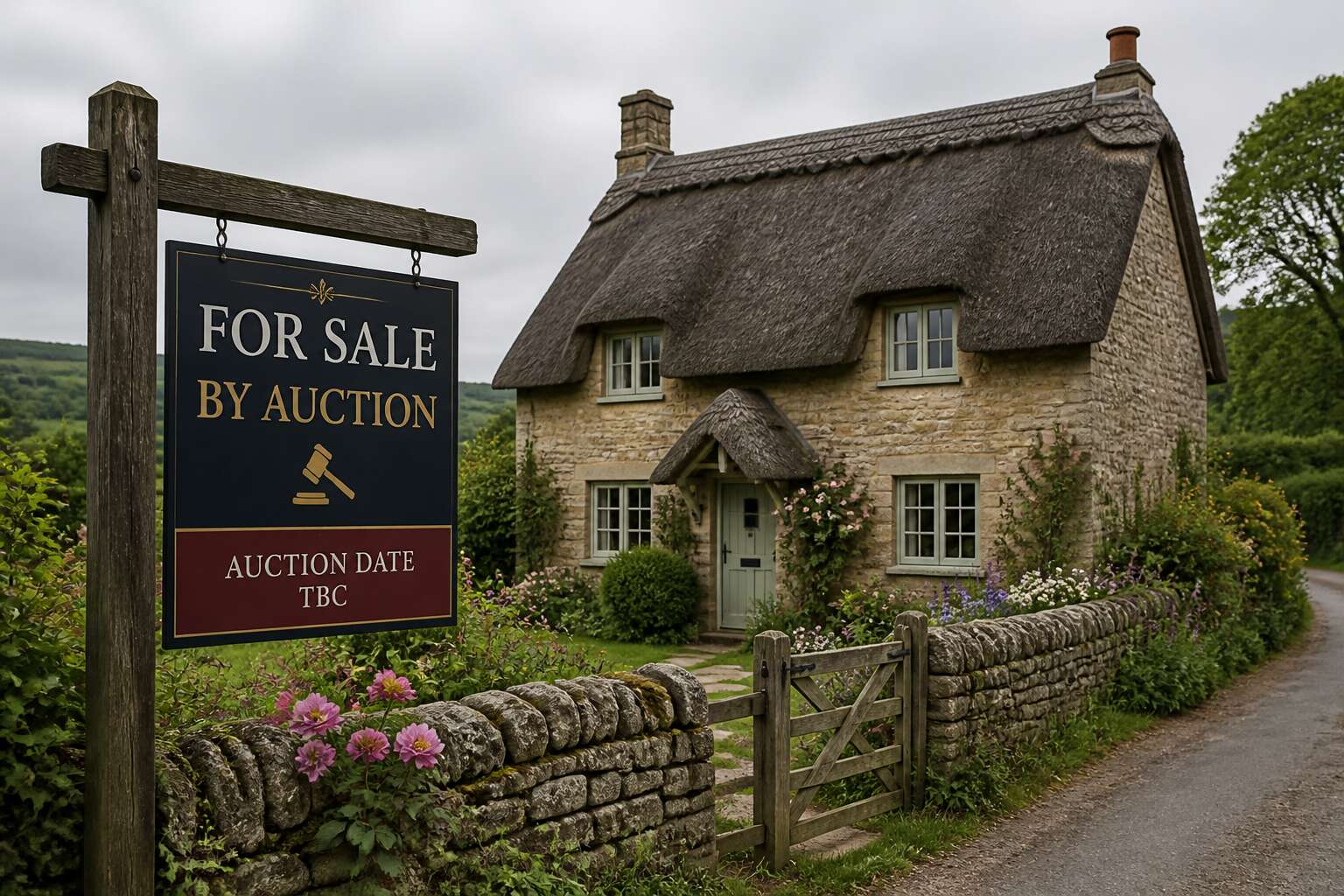
The ABCs of Buying at Auction in Dorset
How Auction Sales Work in the UK
Five minutes before the auctioneer’s gavel falls, a stranger can outbid months of planning. That is the magic of the British auction room. In Dorset, the process follows a rhythm unique to the UK. I have watched seasoned investors lose to a first timer! The auctioneer guides bids upward in increments called bidding steps.
Before any lot is called, the legal pack is available for inspection, including the contract, title deeds, and special conditions. Read it, because once the hammer falls, you are legally bound. The deposit is typically ten percent, due immediately, with completion within twenty eight days.
Consider the essentials:
- Register your details with the auction house.
- Arrange proof of funds before the sale.
- Commission a survey of the property.
Some auctions now run online with livestream bidding. Yet the same rules apply. Searching for property for auction dorset reveals a market where preparation and nerve decide the winner.
Legal Obligations for Buyers
Each property for auction Dorset carries a legal burden that surprises uninitiated buyers. When the hammer falls, you have exchanged contracts. There is no cooling off period. You are bound by the auctioneer’s conditions, often the Joint Auctioneers Conditions of Sale, alongside any special conditions in the contract. If you fail to pay the balance on the agreed date, the seller can rescind the contract, retain your deposit, and sue for their losses. This is not theoretical. I have seen defaulters lose thousands.
Your duties extend beyond the fall of the gavel:
- Stand by your bid once accepted.
- Arrange insurance immediately after exchange.
- Confirm whether VAT applies to the lot.
The vendor owes no duty of care for catalogue errors. Reliance on your own searches and inspections is the whole game.
Choosing the Right Auction House
Choosing an auction house carries a subtle psychological weight. The venue shapes the energy in the room, influencing your bidding confidence. When you evaluate a property for auction Dorset, consider who stands to benefit from your keenness. Their fee structure and marketing reach are not passive details; they are the measure of their transparency!
I have learned to trust the quiet attentiveness of a specialist firm over the polished volume of a national chain. The human nature of the auctioneer matters. There is a distinct consolation in working with someone who knows the land, understanding the paperwork’s limits.
- Are their vendor’s terms clearly stated?
- Do they welcome pre-auction questions without evasiveness?
- Is the lot document pack easily accessible?
A property for auction Dorset is never a faceless transaction. Your choice of house tells you exactly how much risk you are willing to accept.
Finding and Vetting Dorset Auction Lots
Top Sources for Auction Catalogues
Experienced bidders rarely rely on the photographs alone. The hunt for a property for auction dorset begins with the catalogues, which auction houses publish four to six weeks prior to the sale. Their websites are the primary source, but do not stop there! Independent agents frequently hold off-market lots that never reach mainstream print.
For a wider net, national platforms aggregate regional sales. These portals link directly to legal packs and guide prices. A thorough vetting process demands you cross-reference every entry against HM Land Registry records. Consider these trusted sources:
- Regional auction house portals and their direct email alerts.
- Specialist property listing websites with auction filters.
- Local solicitors who receive sale notices in advance.
Cross-checking title deeds and planning history gives you the clarity that glossy photos often hide.
Assessing Property Value and Condition
Catalogues rarely show the bulging wall or the roof that has surrendered to gravity. A property for auction dorset requires curious eyes and a stubborn nerve. You must reach beyond the guide price and interrogate the actual stone, timber, and damp. Bring a builder who speaks plainly, or at least someone willing to crawl into crawl spaces.
- Check the condition of the roof and drainage, since water finds every weakness.
- Inspect for damp, both obvious and disguised behind fresh paint.
- Review the electrical and heating systems, which could eat your budget whole.
Value emerges from evidence, not optimism. Compare sold prices in the area, then subtract the cost of every flaw you uncovered. The guide price is a starting point, not a promise. A property for auction dorset might look like a bargain, until you add the repairs, the waiting time, and the extra grey hairs.
Financing Your Purchase
Most auction rooms in Dorset hide their best lots in plain sight. I have spotted a property for auction dorset that everyone walked past, because the photos did nothing and the guide price scared off the casual buyer. The real work happens before you even pick up the phone!
Vetting means digging into local records. Check title deeds, previous sales, and any notices attached to the land. A quick look at drainage maps can save you later.
Financing is where amateurs stumble. Auction completion deadlines arrive fast. Cash or bridging finance offers the most certainty. I prefer to have my funds ready to transfer the moment the hammer drops.
Auctioneers expect a 10% deposit immediately after the sale. Get your solicitor to confirm they can exchange contracts within days, not weeks.
Conducting Local Area Research
Some of the best property for auction dorset hides in plain sight. I once walked past a terrace cottage three times because the estate agent’s photos showed only a dark hallway. Vetting begins with the title plan. Compare the boundaries to the actual fence line, not the faded red line on a PDF.
Then do the boring, essential work. I make a habit of checking the following:
- Flood risk from the Environment Agency even if the seller says no
- Local parish meeting minutes for planning squabbles
- The date the wheelie bins go out, which reveals occupancy patterns
The street itself tells the rest. Walk at 6pm and on a Saturday morning. Talk to the person pruning the hedge. One retired plumber told me exactly where the old drainage ran, saving me a costly survey. That is the real research, and it beats any online portal.
Smart Bidding Strategies for Dorset Auctions
Setting Your Maximum Bid
Auctioneers in Dorset see the same scene every month. Bidders sit with folded arms, then a farmhouse comes up and they bid far past their limit. Your maximum bid is the only number you control under pressure.
I have watched successful buyers write that number on their hand before the lot is called. They deduct survey costs, legal fees, and the quiet dread of a damp roof. The figure feels like a loss, but it is a boundary.
- Match the number to your mortgage approval
- Add ten percent for unseen repairs
- Write it down and do not cross it
Your maximum bid for any property for auction dorset must survive the auctioneer’s stare, the crowd’s silence, and your own pulse. When you stay under it, you protect yourself from a long list of regrets.
Understanding Reserve and Guide Prices
The reserve price stays hidden, while the guide price is a published estimate. These numbers rarely align, and that gap creates the opportunity for smart bidding. In a Dorset auction room, the guide may be set low to attract attention, but the reserve represents the seller’s true minimum. A bidder who mistakes one for the other loses time and money.
I once watched a cottage in Bridport sit unsold because bidders stopped at the guide, assuming the reserve sat just above. It did, but their hesitation let the lot pass. Understanding the discipline between these figures changes how you approach the gavel.
For any property for auction Dorset, ask the auction house directly whether the reserve sits close to the guide. Some sellers move the guide down to increase interest, knowing the reserve will never follow. Others set the reserve below the guide with genuine urgency.
Online vs. In-Room Bidding
The saleroom and the screen reward different instincts entirely. Online bidding unfolds in silence, numbers climbing while faces remain hidden. In-room bidding adds human pressure, the auctioneer sensing who might stretch further. Any property for auction Dorset can produce wildly different final prices depending on the room you choose.
Speed works differently in each format:
- Online platforms favour the patient bidder who waits until the final seconds.
- In-room bidding rewards early momentum, but it can also reveal desperation.
I have watched both approaches succeed and fail with equal regularity. Online, you see only the bid history and the clock! In the room, every gesture stays visible. Neither path forgives a bidder who loses their nerve.
Reading the Auction Room
The auction room in Dorset reveals truths that no catalogue can convey. I have watched bidders reveal their maximum through a single twitch of the chin. The trick lies in reading the room, not the lot sheet. Every glance holds meaning.
Certain gestures recur with telling frequency.
- Closed eyes before a bid often mean a mental calculation, not certainty.
- A quick glance at a partner signals an unprepared limit.
- Stillness after a raise suggests the bidder has reached their boundary.
The auctioneer’s pause carries information. A prolonged silence invites a rival’s counter, while a rapid continuation punishes hesitation. A property for auction Dorset often reflects these human signals, and those who study them gain a clearer view.
Avoiding Overpaying Through Emotion
In a Dorset auction room, sensible people overpay for things they never wanted. I once watched a bidder claim a parking space, then ask where the property was. The property for auction Dorset circuit punishes that sort of distraction. Your best defence is a pre-committed limit, written down and sealed before the gavel falls. Subtract ten percent from that figure to account for adrenaline.
A practical method is to assign bidding to a delegate. Hand your paddle to someone with no emotional stake. They will raise it when you nod, not when your blood rises.
Three rules:
– Fix your ceiling on paper.
– Use a delegate for all bids.
– Walk away at the number.
The auctioneer will smile, but the smile is not for you. It is for the commission.
After the Hammer Falls: Next Steps
Deposit and Completion Timelines
The auctioneer’s gavel is only the beginning. For a winning bidder, the next few minutes carry more weight than the entire bidding war. You must pay a deposit immediately, usually 10% of the purchase price, before leaving the room. Cash, bank transfer, or a banker’s draft are typically accepted. No exceptions.
Completion follows a strict timeline, commonly 28 days from the auction date. For property for auction dorset, this period is fixed in the contract you signed. The same deadline applies whether you are a first-time buyer or a seasoned investor. Missing it means losing your deposit and facing legal action.
Your immediate priorities break down as follows:
- Transfer the deposit and sign the contract.
- Arrange your mortgage or bridging finance.
- Instruct a solicitor to prepare completion.
Each step has its own deadline. The contract defines them all.
Transferring Ownership
The hammer falls. The room exhales. But ownership does not transfer with applause. Buying property for auction dorset does not end with the gavel. The legal title moves through a chain of documents, not handshakes. I have watched buyers walk out of the room believing the property is theirs. Legally, that moment is still ahead.
Your solicitor will lodge the transfer deed with HM Land Registry. This is the pivotal act. Until registration completes, the seller remains the legal owner. You hold equitable rights, but the register holds the truth.
The process involves:
- Drafting the transfer deed
- Paying Stamp Duty Land Tax
- Submitting the application to HM Land Registry
Each step has a defined window. In Dorset, local searches and requisitions must be resolved before submission. The title registers in your name only after the Land Registry processes the application. That is the moment ownership truly changes hands.
Renovation Planning and Budgeting
Renovation planning begins the day the hammer falls, not the day you collect the keys. With property for auction Dorset, the condition report is your starting point, but it will not show the rot behind the plaster. Budget for the invisible.
Set aside a contingency of at least fifteen percent. That is not caution; it is arithmetic. Surveyors’ estimates are often optimistic, and builders’ quotes have a way of expanding once walls are opened.
Structure your budget in layers:
- Essential structural repairs
- Systems: electrics, plumbing, heating
- Cosmetic finishes
Each layer must be funded before the next begins. And do not forget the cost of holding the property: council tax, insurance, security. These accrue while you work.
Plan for the time as much as the money. A Dorset stone cottage will not dry out in a week. Renovation is a sequence, not an event.
Managing Unexpected Costs
The hammer falls. The property is yours. What follows is the quiet phase where most buyers lose their nerve. When you buy a property for auction Dorset, the legal completion date sets the tempo, but the costs that appear in between are rarely on the catalogue pages.
A roof leak surfaces in the first storm. A boundary dispute emerges when the neighbour finally speaks to you. The surveyor’s caveats become a ledger of their own.
Unexpected expenses cluster in three forms:
1. Structural discoveries, such as a crumbling chimney stack
2. Holding costs, including empty property insurance and security
3. Legal fees for disputes that surface after the signing
Each one arrives without warning. The buyers who manage them well do not panic. They simply treat the unexpected as part of the price.
Selling or Letting Your Auction Purchase
Profitable auction purchases are defined by their exits. If you secured a property for auction dorset with resale in mind, market timing outweighs renovation polish. A quick sale beats a slow sale chasing an extra five percent.
Letting the purchase runs differently. Tenants value a working boiler and a dry roof over the details that drew you in. A sound tenancy agreement protects your yield. The voids between occupants erode returns more quietly than any repair invoice.
Before choosing either path, examine the title for encumbrances. I have seen flips collapse for want of a covenant check. Linger on the small print:
- blanket bans on subletting
- consent clauses requiring freeholder approval
- occupancy limits tied to rural land use
Each one alters your exit price.
The decision shapes your holding period, your finance structure, and the insurance lines you carry. No auction catalogue tells you which one fits.
Learning from Successful Dorset Investors
The room falls quiet when the hammer drops. For experienced Dorset buyers, that quiet is the signal to move. They do not celebrate. I have watched buyers linger at the rostrum while the next lot begins. That hesitation costs money.
The first call goes to the auction house office to confirm the signed contract is processed. The second goes to your insurer. Few people realise a property for auction dorset becomes your liability at the moment you win, not at completion.
Successful investors keep a post sale ritual. They revisit the property within 72 hours, before any builder arrives.
- Photograph every room with date stamps
- Compare the current state to the catalogue description
- Note any defects for the tradesmen’s tender
That evidence shapes the renovation quote and the exit price. The gavel starts a clock that does not pause! What you do in three days decides what the purchase is worth.




0 Comments