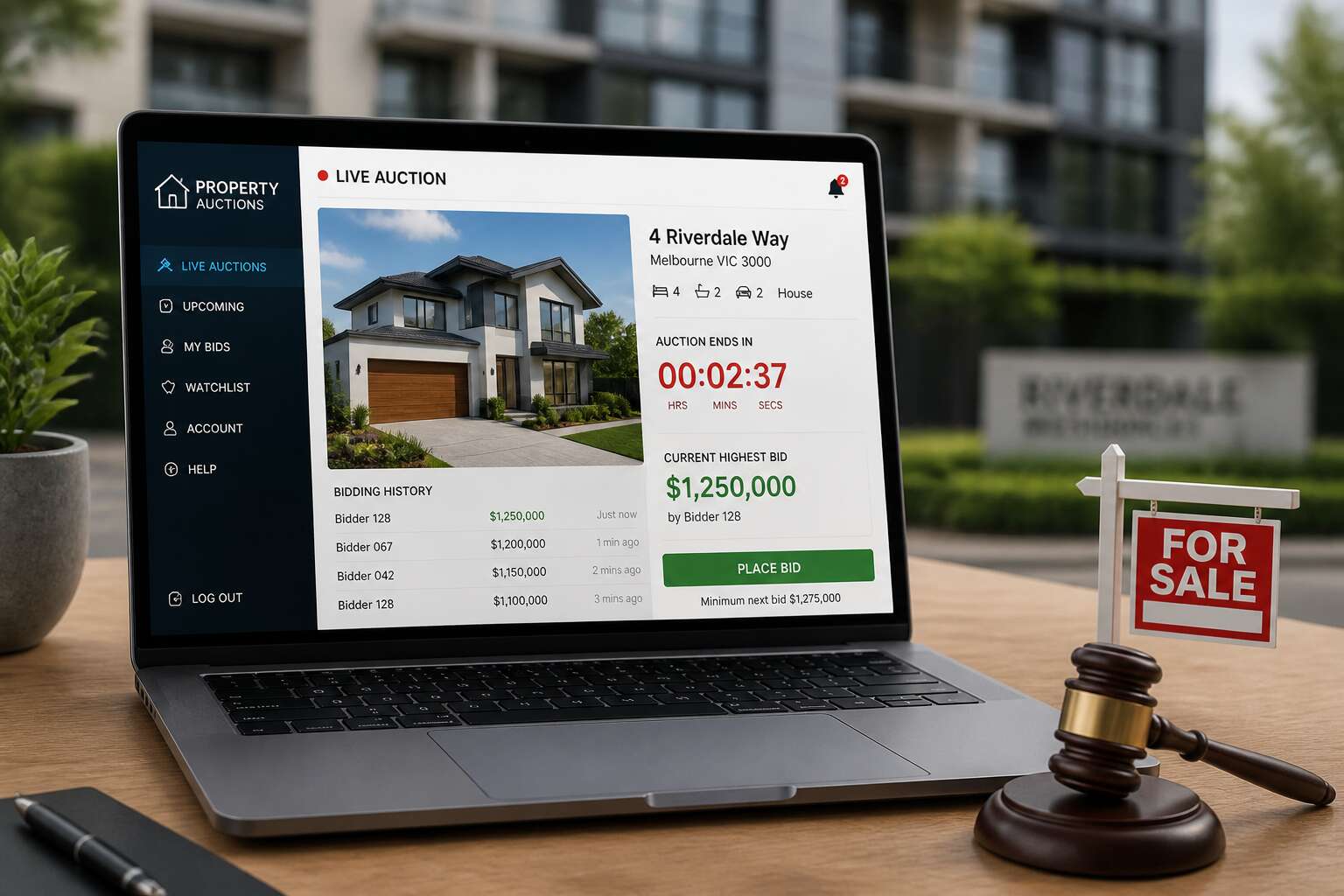
Understanding Online Property Auctions
What Are Online Property Auctions?
Property auctions online have removed the theatrical side of the traditional auction room. The auctioneer’s chant is now a timer on your screen, and the paddle is a mouse cursor. It remains a public sale, but the process runs faster and creates less anxiety.
In any property auctions online event, the seller sets a reserve price and bidders register beforehand. Once the window opens, you place bids remotely and watch the numbers climb! The system logs every counterbid, and the highest offer wins when time expires.
- Reserve price: the minimum amount the seller will accept.
- Registration: requires proof of identity and a deposit.
- Winning bid: a 10% deposit is usually due immediately.
That is the whole mechanism, minus the sweat and the frantic arm waving.
How Do They Differ from Traditional Auctions?
In a traditional auction room, a nod or a raised finger can be missed. Property auctions online remove that risk entirely. Every bid is timestamped and visible to all participants, which means no ambiguous gestures and no disputed offers.
The pace also shifts. A physical auction often rushes through lots in minutes, leaving little time to consider your limit. Online, the countdown timer gives you a clear window, and you can track competing offers without the pressure of a live crowd.
Consider the practical differences:
- Inspection periods are longer, often with digital documentation available.
- You can bid from anywhere in South Africa, not just the venue.
- Payment deadlines remain strict, but the process is fully auditable.
These changes make property auctions online more transparent, though they still demand the same disciplined approach.
Key Terminology and Legal Framework
Property auctions online have their own lexicon. Reserve price names the lowest amount a seller accepts. Bid increment sets the minimum raise. Buyer’s premium is the fee added to your winning bid. Misfire on these terms and you mistake a legal obligation for a suggestion.
South Africa’s legal framework adds a binding layer. The Consumer Protection Act governs auctions run by intermediaries. Each listing discloses the seller’s status, the property’s defects, and all conditions of sale. The auctioneer’s terms, once accepted, carry contractual force. These documents hold legal status before any offer is placed.
- Signature of the bidder registration form is a binding agreement.
- Payment deadlines are absolute; no extension exists.
- Failure to pay triggers resale and a claim for damages.
Property auctions online mirror this structure with transparency. The digital record of each bid becomes part of the contractual evidence. A bidder’s agreement forms at registration, not the final call.
Pros and Cons of Bidding on Property Online
Advantages: Convenience and Global Access
Auction rooms once demanded your presence. With property auctions online, a buyer in Sandton can bid on a farm in the Free State while the coffee cools. The convenience is practical, not poetic.
Global access means a seller’s audience spans continents. I have watched a Johannesburg buyer compete with someone in Perth for a seaside flat in Umhlanga.
- Skip travel and queue time entirely.
- Monitor multiple auctions using one screen.
Disadvantages: Lack of Physical Inspection
The listing shows a manicured lawn. The drone footage makes the house look immaculate. But you cannot smell the damp rising through the floorboards, and you cannot see the crack running behind the freshly painted wall. Participating in property auctions online means bidding on a description, not a building you have walked through. The physical inspection gap is your biggest risk. Certain facts never make it onto a screen:
- The borehole’s yield and water quality
- The condition of the thatch roof and its fire rating
- The actual boundary lines and any encroachments
- Whether the access road is passable after heavy rain
Discovering these problems after the auction is expensive. A buyer in Pretoria can win a bid on a farm in Limpopo without ever standing on the soil. That is the trade-off.
Hidden Fees and Financing Challenges
The hammer falls. Your heart races. Then the fees arrive, unbidden heralds of the true cost. Buyer premiums, VAT on commission, transfer duties, and the quiet sting of an auctioneer’s administrative charge gather like morning mist, obscuring the price you thought you had secured.
Financing performs its own peculiar dance. Banks move in measured steps; auctions demand speed. A successful bid binds you within days, not weeks. The cash buyer glides through while the bond applicant watches from the doorway, hope thinning like winter light.
Consider the ledger of hidden costs:
– Buyer’s premium, often 5% to 10% of the hammer price
– VAT on the premium and legal fees
– Transfer duty and conveyancing costs
– Risk insurance from the fall of the hammer
– Municipal rates and levies in arrears
Property auctions online carry these spectral companions. Master the full ledger before you raise your paddle, and the arena becomes less a gamble and more a calculated art.
Strategies to Mitigate Risks
The auction clock does not pause for reflection. Online bidding strips away the physical room, leaving only the counter and the countdown. You watch each increment land in real time. That visibility is a genuine advantage. Yet the same speed can betray you. A delayed click or a faltering connection ends the contest in seconds. I have seen keen bidders lose property auctions online because of a frozen screen.
The remedy lies in a disciplined framework:
- Set your maximum price before the auction opens and do not adjust it.
- Run the platform’s practice mode on the device you intend to use.
- Confirm bond approval or available cash before you raise your hand.
These steps turn property auctions online into a measured campaign. They do not remove the risk. They reduce it to a level you can manage.
A Step-by-Step Guide to Participating in Online Auctions
Pre-Registration and Identity Checks
Somewhere between the gavel’s final fall and the transfer of funds lies a less glamorous, yet critical process. Before you can raise a virtual paddle, the platform demands proof of who you are. This pre-registration phase is your first test of legitimacy. The scrutiny is often more intense than you expect. Platforms are legally bound to verify your identity and source of funds. This is not bureaucracy for its own sake. It is the first barrier against fraud and a safeguard for the seller.
Your application will typically require standard documentation. For South African residents, this usually means a copy of your ID and proof of residence. You will also need to provide financial references. The platform may conduct a credit check to confirm your standing. This is where first-time bidders sometimes falter. The financial checks are not merely a formality; they establish your credibility in a high-stakes environment.
The entire process is seamless and can be completed from your desk in under an hour.
– Standard identification, often a green ID book or smart card.
– A recent municipal account for proof of residence.
– Bank confirmation letters or a pre-approval certificate from your bond originator.
Once your documents are accepted, you will be granted a bidder number. This number is your only identity during the auction. It protects your privacy from other bidders. However, the verification does not stop there. You may be required to sign a buyer’s agreement digitally. This contract binds you to the rules of the property auctions online, including the payment timeline and the 10% deposit.
Failing this step means you are simply a spectator. The door is firmly shut. A rejected application, often due to vague financial details, can be a blessing in disguise. It prevents you from bidding without the necessary capital. The platform is not punishing you; they are preventing a future legal dispute. The identity check is the quiet, unseen anchor that keeps the entire process from drifting into chaos. It is the difference between a calculated investment and a costly mistake.
Setting a Realistic Budget and Maximum Bid
At property auctions online, the disciplined participant, I have learned, is not the wealthiest. It is the one who has already decided their limit. A realistic budget is a necessity. Without it, the auctioneer’s pace will push you into overpaying.
Establish your ceiling. That figure must include the 10% deposit, transfer costs, and hidden levies. Your maximum bid should be a hard number, not a sentiment. Write it down. Commit to it. Emotion will tempt you to revise that number upward. Do not!
Consider these factors when setting your budget:
- The forced sale value, not the retail value
- Arrear rates and municipal debts attached to the title
- Cost of immediate repairs or vacancy
In property auctions online, informed buyers treat the maximum bid as a boundary. The objective is to buy below your comfort threshold. That margin protects you once the gavel falls.
Virtual Viewings and Researching the Property
The path to winning a property at auction starts long before the bidding opens. Your first move is to locate listings on reputable platforms that host property auctions online, then shortlist the lots that match your criteria. Next, schedule a virtual viewing. While you cannot walk the floor, a live video walkthrough reveals the true state of the interior, the roof line, and the general upkeep. This step filters out the properties that will drain your cash reserves.
After the viewing, dig into the municipal records. Confirm the exact erf size, check for outstanding rates, and verify the title deed restrictions. These documents often hide surprises that the listing photos never show. Once the paperwork checks out, register for the sale and prepare your bid. The entire process rewards patience and methodical checks, not impulse.
Understanding Bidding Increments and Auto-Bid Features
Understanding bidding increments is your first step to mastering property auctions online. These fixed jumps, often 5% to 10% of the current price, keep the pace fair and predictable. Before you click, study the increment table on the auction platform. It tells you exactly what your next offer must be.
Auto-bid is your silent ally. Set your maximum price, and the system will place incremental bids on your behalf, only up to that ceiling. This removes emotional overbidding and lets you stay competitive while you attend to other tasks. Here is how to use it wisely:
1. Set your auto-bid limit at or below your researched budget.
2. Watch the live countdown; the system reveals competing bids.
3. Adjust your manual bids only if the increment exceeds your ceiling.
Remember, auto-bid does not guarantee a win. It simply levels the field. For property auctions online, this feature protects your interests without constant screen watching. Master it, and you will bid with confidence, not chaos.
Top Platforms for Online Property Auctions
General Real Estate Platforms
General real estate platforms host property auctions online. They aggregate residential stands, commercial warehouses, and distressed agricultural land into a single catalogue. Unlike niche marketplaces, these platforms manage volume. They operate on familiar models: the timed auction and the live simulcast.
Popular general platforms in South Africa include:
- Auction Alliance
- Broll Auctions
- High Street Auctions
Each portal maintains a relentless auction calendar. Some specialise in foreclosures, others in municipal sales. Bidding lasts for days or minutes, depending on the model. Some platforms allow real-time bidding against local rivals; others accept participants from other countries. The result is a marketplace where the property itself, not the ceremony, decides the price.
Specialized Auction Houses for Distressed Assets
The top platforms for online property auctions in the distressed niche move with precision. When a bond defaults or an estate collapses, general portals rarely linger. Specialized houses such as Park Village Auctions take over. Others, tied to specific liquidators, work directly with trustees. I find their schedules unpredictable, and that is precisely the point!
These nimble platforms run property auctions online. They know the exact day a bond default becomes a legal sale. Their catalogues are direct. A buyer in Cape Town can bid on a Mpumalanga orchard without leaving the office. Each auction demands its own paperwork.
- Insolvency sales
- Judicial repossession
- Estate liquidations
The hammer falls at hours that suit the liquidator, not the crowd.
Government and Foreclosure Auction Sites
The Modern Shift to Digital Auction Platforms
Property auctions online have transformed how real estate is bought and sold. This digital approach offers a clear alternative to traditional rooms. It provides access to a wider range of assets, from residential homes to commercial buildings. The process is straightforward.
Online platforms highlight key advantages for bidders. These include increased transparency and greater convenience. You can participate from any location without travel. The digital format often reveals more detailed property histories. Buyers can conduct thorough research before placing a bid.
Many platforms feature user-friendly filters. You can search by location, property type, or price range. This makes it easy to find specific opportunities. Detailed listing descriptions and high-resolution images are standard. These tools provide a comprehensive view of the asset.
Ultimately, a property auctions online guide helps you navigate sales confidently. It allows you to make informed decisions in a dynamic market. This method effectively connects motivated sellers with serious buyers.
Comparing Fees and User Experiences
Comparing top platforms for property auctions online reveals significant differences in both fees and user satisfaction. Auction.com typically charges a buyer’s premium between 5% and 10%. Regional players like BidX1 use a lower flat fee but require a non-refundable registration deposit. User experiences vary just as much. Some portals offer seamless mobile bidding and live video streams. Others rely on clunky legacy interfaces.
Consider these key differences:
– Auction.com: High buyer’s premium, extensive due diligence documents.
– BidX1: Transparent bidding history, but stricter pre-approval.
– South African platforms like Harcourts Auctions: Negotiable buyer’s premium, personal agent support.
The winning choice depends on whether you prioritise transparency or lower upfront costs. For South African buyers, platforms like Harcourts Auctions provide negotiable buyer’s premiums with personal agent support. Always verify the total cost, including VAT and transfer duties, before placing a single bid in any property auctions online.
Common Pitfalls and Expert Tips for Beginners
Avoiding Overpaying Due to Emotional Bidding
At property auctions online, the digital countdown creates pressure. A disciplined budget evaporates when the timer dips below ten seconds. Beginners stumble because they treat the bidding as a contest against strangers, when the true opponent is their own impulse. Losing a bidding war stings, but paying R50,000 over market value stings for years.
Structure your approach like a professional. Before the session starts, declare your maximum bid privately and commit to it out loud. Write it down. That physical act creates a memory your brain cannot talk its way around when adrenaline surges. When the bidding accelerates, slow your breathing and watch the increments, not the competitors.
The costliest mistakes happen in the final thirty seconds. That is when clarity matters, and when emotion moves fastest.
The Importance of Legal Due Diligence
The gavel falls online, and within seconds, a bidding war erupts. For the uninitiated, the allure of a bargain property can quickly dissolve into a costly lesson. The most common pitfall? Mistaking motivation for momentum. Beginners often bid against their own excitement rather than the property’s intrinsic value, especially when the countdown timer on property auctions online creates a false sense of urgency. This adrenaline rush rarely ends well.
A few practical habits separate the seasoned investor from the casual spectator. Attend several auctions without bidding to understand the rhythm. Set a strict ceiling based on comparable sales, not the auctioneer’s opening figure. Most importantly, walk away the moment the numbers no longer make sense, regardless of how much you have already invested in the chase. The discipline to leave empty-handed is the most profitable skill you will ever learn.
Due diligence, however, forms the true bedrock of any successful purchase. The auction catalogue is a starting point, not a guarantee. You must verify the title deed for any restrictive conditions or servitudes that could devalue the land. Confirm whether the seller has obtained compliance certificates for electrical installations or plumbing. Check outstanding municipal rates and levies, as these debts often transfer to the new owner. Review the specific conditions of sale, particularly the payment deadlines and the deposit required upfront, since property auctions online operate on non-negotiable terms.
Here is a practical checklist for your pre-auction research:
– Search the deeds office for any bonds, interdicts, or caveats registered against the property
– Visit the local municipality to confirm the exact rates and any approved building plans
– Engage a professional inspector to assess structural integrity, damp issues, or roof damage
– Ask the auctioneer directly for the seller’s disclosure document regarding latent defects
The legal fine print rarely makes for entertaining reading, but it contains the difference between a sound acquisition and a quiet disaster. If the property is occupied, establish whether a lease exists and for how long. If it was repossessed by a bank, understand that the previous owner’s personal circumstances do not affect the transfer process. Every detail must be confirmed in writing before the bidding opens, not after the hammer falls.
The true experts treat the auction room as a boardroom. They arrive armed with financing already approved and a precise understanding of market value. They know that property auctions online offer convenience, but the same rules apply: research replaces regret, and preparation prevents loss. The buyer who panics pays too much. The buyer who prepares can secure a genuine opportunity. The choice between these two outcomes is made long before you ever place a bid.
Post-Auction Procedures and Contingencies
The auctioneer’s gavel falls online, but your obligations have only just begun. In South Africa, the winning bid converts into a legally binding contract the moment the auction closes. Many beginners assume they can walk away if they spot a defect the next morning. They cannot. Expect to pay a 10% deposit immediately, with the balance due within a defined period, often 30 days.
Contingencies are rare in this arena. Property auctions online rarely permit suspensive conditions such as “subject to bond approval.” Your financing must be pre-arranged! One experienced buyer I know keeps a conveyancer on standby before bidding, because transfer timelines wait for no one.
- Confirm the auction house’s specific transfer process before you bid
- Arrange bridging finance if your existing bond is delayed
- Request the auctioneer’s conditions of sale in writing
The buyer who treats post-auction administration with the same urgency as the bidding itself tends to sleep better. Property auctions online demand this level of preparation.
Future Trends in Digital Property Auctions
Beginners often misjudge the tempo of property auctions online. The bidding escalates in seconds, and hesitation costs more than overbidding. One new bidder I know lost a modest flat because he waited to see who else was bidding. By the time he acted, the reserve had passed. Experienced buyers prepare before the feed goes live. They have tested their connection, studied the increments, and committed to a ceiling in writing.
- Run a test bid on the platform before auction day
- Write your maximum bid on paper and keep it visible
- Ask the auction house about planned system upgrades
Future trends lean toward automation. South African platforms are adopting algorithmic valuations and digital identity verification. Some auction houses now pre-approve bidders through secure portals, reducing the risk of fraud. Blockchain ledgers are also entering the conveyancing space. This could shorten transfer timelines considerably once the hammer falls.




0 Comments